
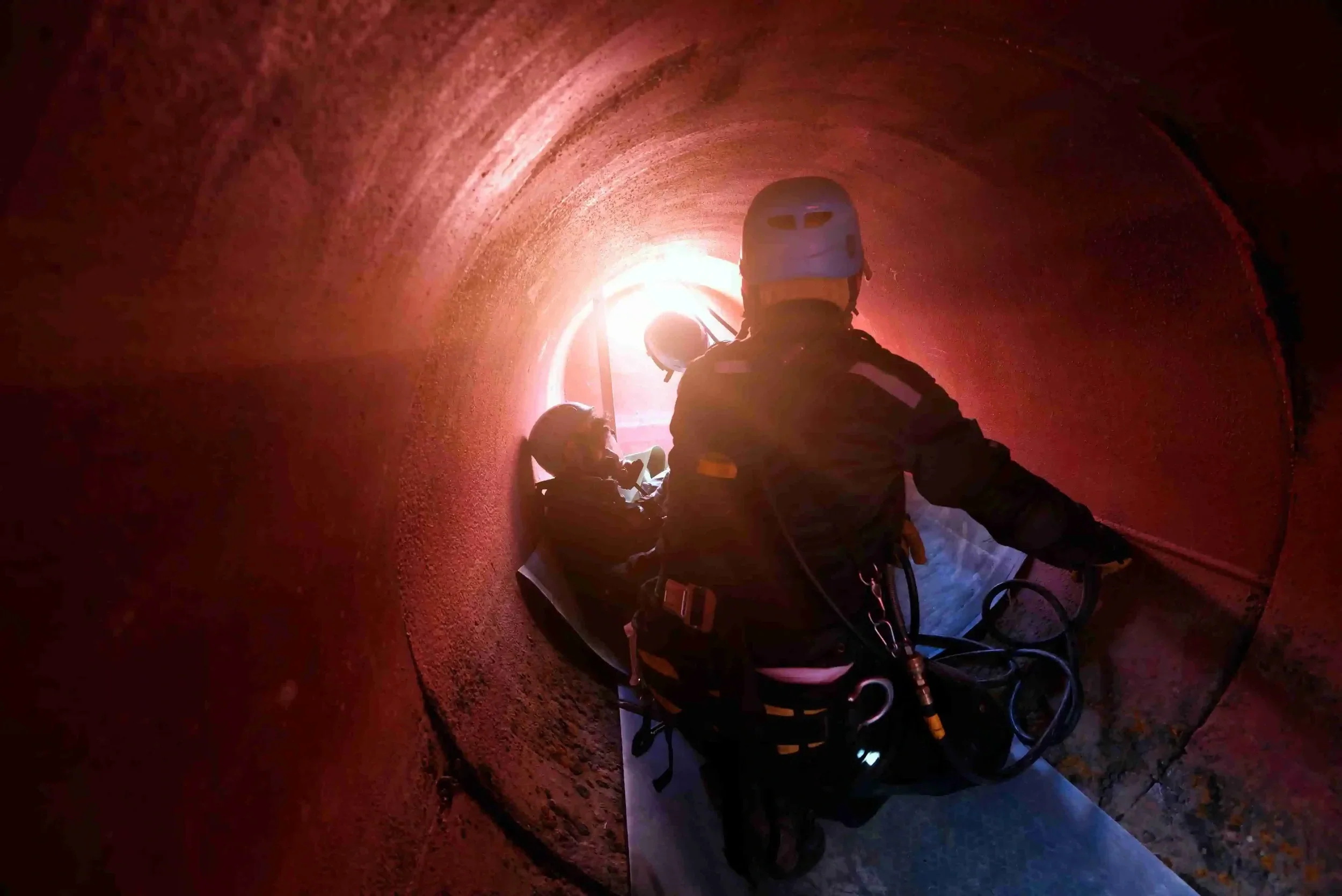
Confined Space Rescue Services.
Professional emergency response and rescue provision for high-risk work environments.
Confined space work can present serious risks to those carrying out the work. Suitable and sufficient arrangements for rescue must be in place before work begins, taking account of the specific risks associated with the confined space and the work being undertaken.
What is confined space rescue?
Confined space rescue is the planned and controlled recovery of a person who becomes injured, unwell or trapped within a confined space where normal access and escape are restricted.
Confined spaces can present hazards including oxygen deficiency, hazardous atmospheres, flooding, mechanical entrapment and restricted or vertical access. Rescue arrangements must take account of the hazards identified, with appropriate personnel, equipment and procedures in place to carry out a rescue without exposing others to unnecessary risk.
Common examples of confined spaces include
Manholes, chambers and shafts
Tunnels and culverts
Tanks, silos and vessels
Sewers and drainage systems
Pits, sumps and voids
When is confined space rescue required?
Under the Confined Spaces Regulations 1997, suitable and sufficient arrangements for the rescue of persons in the event of an emergency must be in place before anyone enters or carries out work in a confined space.
This means:
Rescue arrangements must be planned in advance
Reliance on the emergency services alone is not considered sufficient
Rescue arrangements must include appropriately trained personnel and suitable equipment, based on the risks identified
DEDICATED CONFINED SPACE RESCUE PROVISION MAY BE APPROPRIATE WHERE:
Entry involves a risk of serious injury or death
The space is difficult to access or evacuate
Atmospheric hazards may be present
Vertical or technical rescue techniques are needed
Why professional rescue provision matters
Poorly planned or improvised confined space rescues can place additional people at serious risk. Further casualties can occur when people attempt a rescue without appropriate training, equipment or protection from the hazards present.
Using a professional confined space rescue provider can support effective rescue arrangements by providing trained personnel, appropriate rescue equipment and a planned response based on the hazards and requirements of the confined space operation.
Using a professional confined space rescue provider helps to:
Support safer rescue arrangements for workers and rescuers
Provide trained personnel and appropriate rescue equipment
Establish a planned response appropriate to the identified risks
Provide additional assurance that rescue arrangements are in place
Our confined space rescue services
-
Emergency confined space rescue teams
We provide trained and experienced rescue teams capable of responding to confined space emergencies using appropriate techniques and equipment, including casualty packaging, vertical extraction and atmospheric monitoring and control.
-
Standby rescue cover
For confined space entries, maintenance shutdowns and other higher-risk operations, we can provide dedicated on-site standby rescue teams, with rescue arrangements planned around the specific hazards and requirements of the work.
-
Rescue planning and risk assessment
We support duty holders with the development of confined space rescue plans tailored to the specific location, access arrangements, identified hazards and work being undertaken, helping to establish suitable rescue arrangements before work starts.
Compliance with UK confined space regulations
Our confined space rescue services are designed to align with UK health and safety legislation and industry guidance, including the Confined Spaces Regulations 1997.
WE WORK WITH CLIENTS TO SUPPORT:
Rescue arrangements are proportionate to risk
Equipment is appropriate and maintained
Personnel are trained and competent
Emergency procedures are clearly understood
This approach supports compliance, audit readiness and safer working practices on site.
Sectors we support
We provide confined space rescue and standby cover to support high-risk work across a range of sectors, including:
Construction and civil engineering
Utilities and water infrastructure
Energy and industrial facilities
Transport and infrastructure projects
Our services are scalable and adaptable to both short-term works and long-term projects.
Frequently asked questions
-
Under the Confined Spaces Regulations 1997, suitable and sufficient arrangements for the rescue of persons in the event of an emergency must be in place before confined space work begins. The arrangements should reflect the specific risks involved and may include appropriately trained personnel, suitable rescue equipment and established rescue procedures. Reliance on the emergency services alone is not sufficient.
-
Suitable and sufficient rescue arrangements must be in place before confined space work begins. The nature of those arrangements should be proportionate to the risks associated with the space and the work being carried out. Higher-risk or technically complex entries may require dedicated standby rescue personnel and specialist rescue equipment.
-
No. HSE guidance states that employers should not rely on the public emergency services to provide their rescue arrangements. Suitable and sufficient arrangements for rescue must be established before confined space work begins and should be appropriate to the specific risks of the work.
-
Standby confined space rescue involves having a dedicated rescue team on site while confined space work is taking place. The team is prepared to respond in accordance with the planned rescue arrangements if an emergency occurs. Standby rescue may be appropriate for higher-risk entries, complex access arrangements or work where the identified risks justify dedicated on-site rescue provision.
-
Potentially, provided the rescue arrangements are suitable for the risks involved and the personnel assigned to the rescue role have the appropriate training, competence and equipment. The arrangements must also allow them to carry out a rescue without exposing themselves or others to unnecessary risk. Organisations may choose a specialist external rescue provider where dedicated personnel or specialist rescue capability is appropriate to the work.
-
Suitable and sufficient rescue arrangements must be established before confined space work begins. These arrangements should take account of the specific confined space, access and egress, identified hazards, the work being undertaken and the actions required in an emergency.
-
Response requirements should be considered during the rescue planning process and be appropriate to the risks identified. Where S3G provides dedicated standby rescue cover, the rescue team is positioned on site for the duration of the agreed confined space work and prepared to respond in accordance with the rescue arrangements.
-
No. Confined space training prepares people for their roles when working in or around confined spaces, including relevant safety and emergency procedures. Confined space rescue is the operational capability and arrangements required to recover a person if an emergency occurs. The training and rescue requirements should be determined by the nature of the work and the risks identified.
Confined space work demands proper rescue planning
If your project involves confined space entry, speak to us early. We can work with you to establish practical rescue arrangements appropriate to the confined space, the work being undertaken and the identified risks.